
Precision Welding Positioner for Wind Tower Sections Up to 8m Diameter
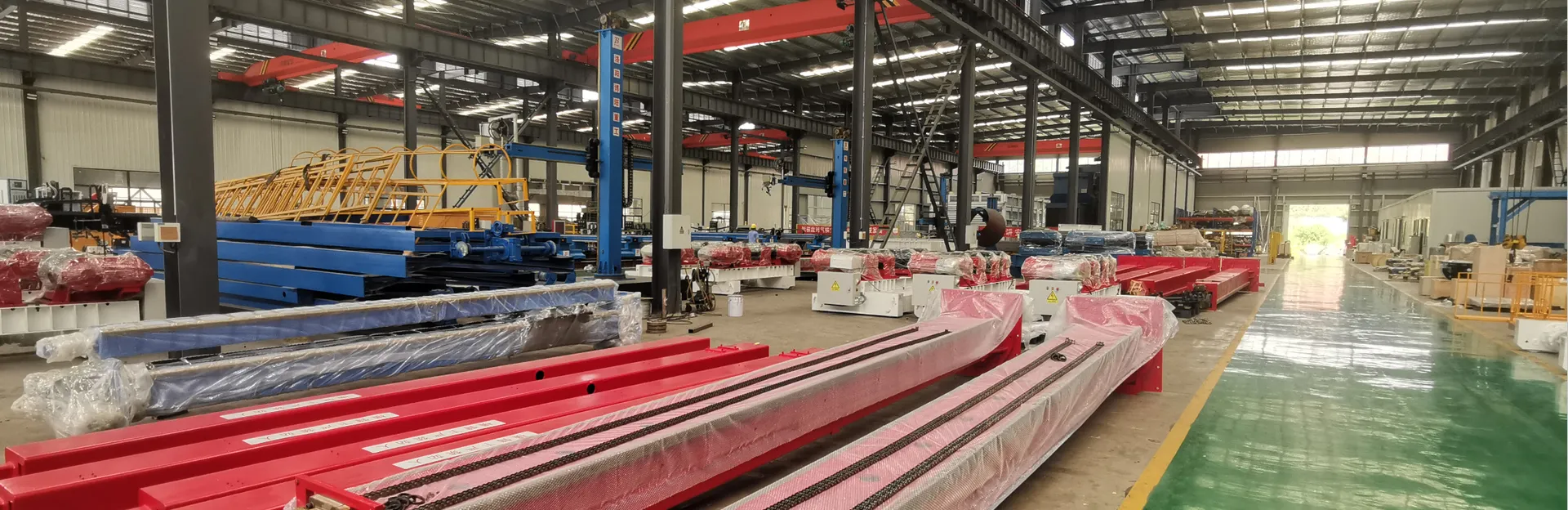
Fabricating wind turbine towers requires welding massive steel sections that can reach 8 meters in diameter and weigh dozens of tons. Achieving consistent weld quality on such large components demands more than a standard positioner—it requires a precision welding positioner engineered for extreme loads, precise rotation control, and seamless integration into automated production lines. This article examines the key factors that make a positioner suitable for wind tower sections up to 8m diameter and explains why BOTA’s solutions deliver the reliability and performance that fabricators need to meet rising quality standards.
Wind tower sections are not only large but also demand tight tolerances to ensure proper alignment during field assembly. A positioner for 8m diameter sections must handle eccentric loads, maintain steady rotation speeds as low as 0.01 rpm, and provide indexing accuracy within fractions of a degree. Conventional two-wheel or standard roller-type positioners often cannot support the combined weight and diameter without risking instability or excessive wear.
Beyond size, the welding process itself introduces challenges: longitudinal seams on conical sections, circumferential welds joining multiple rings, and repair welds on high-strength steel plates. Each scenario requires the positioner to tilt or rotate the part to an optimal welding angle. BOTA’s positioners incorporate dual-axis rotation and variable-speed drives that allow operators to place every weld at the 1 o’clock or 2 o’clock position—the ideal orientation for achieving full penetration and minimal defects.
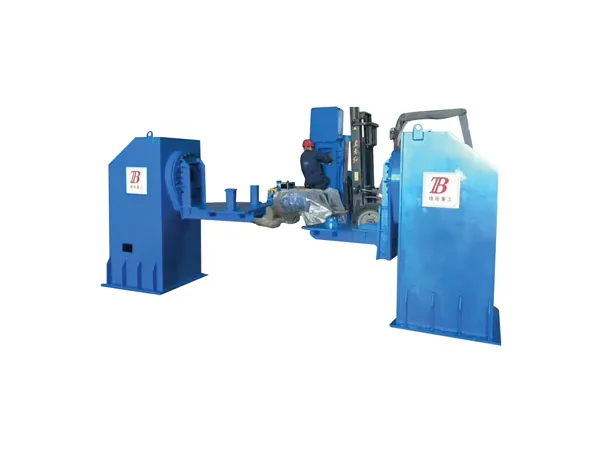
When evaluating positioners for large wind tower sections, three factors separate professional-grade equipment from general-purpose units:
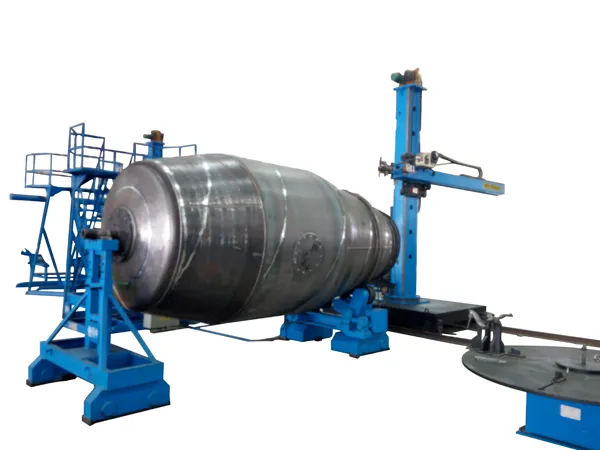
BOTA offers three base platforms: the WPR-6000 (max 6m diameter, 30 t load), WPR-7000 (7m, 45 t), and WPR-8000 (8m, 60 t). Each can be ordered with either hydraulic or mechanical clamping, and with optional tilting headstock for cone-shaped tower sections.
For fabricators moving toward Industry 4.0, BOTA provides custom integration services including laser seam tracking sensors, weld process monitoring, and data logging. The positioner’s control system can execute pre-programmed welding sequences that coordinate rotation speed, tilt angle, and welding parameters—reducing cycle times by up to 30% compared to manual operation.
A leading wind tower manufacturer in Northern Europe recently replaced three conventional positioners with two BOTA WPR-8000 units. After six months of continuous operation, they reported a 25% reduction in rework due to improved weld placement and a 15% increase in throughput. The ability to handle both straight and tapered sections on the same machine simplified their production scheduling.
Another case involves a Chinese tower producer that needed to weld 8m diameter flanges to tube sections. By using BOTA’s positioner with a synchronized tailstock, they achieved concentricity within 0.5 mm across the entire flange circumference—a result that previously required post-weld machining.
Choosing the right precision welding positioner for wind tower sections is a strategic investment in quality and productivity. BOTA’s engineering focus on high-capacity, high-accuracy solutions ensures that fabricators can meet the demanding specifications of modern wind turbines. Contact BOTA today to discuss your specific diameter, weight, and automation requirements.
No. 1 Intersection of Chuangye Avenue and Weilai Avenue,
Yiyang County,Luoyang City, Henan Province, China
+86 400-0379-069
Copyright © 2023 An Automated Welding and Cutting Equipment Manufacturer Focusing on Welding Column Boom and Welding Rotator | All Rights Reserved Technical support: ShangXian