
Seamless Tacking and Welding with Zero-Backlash Rotator Design
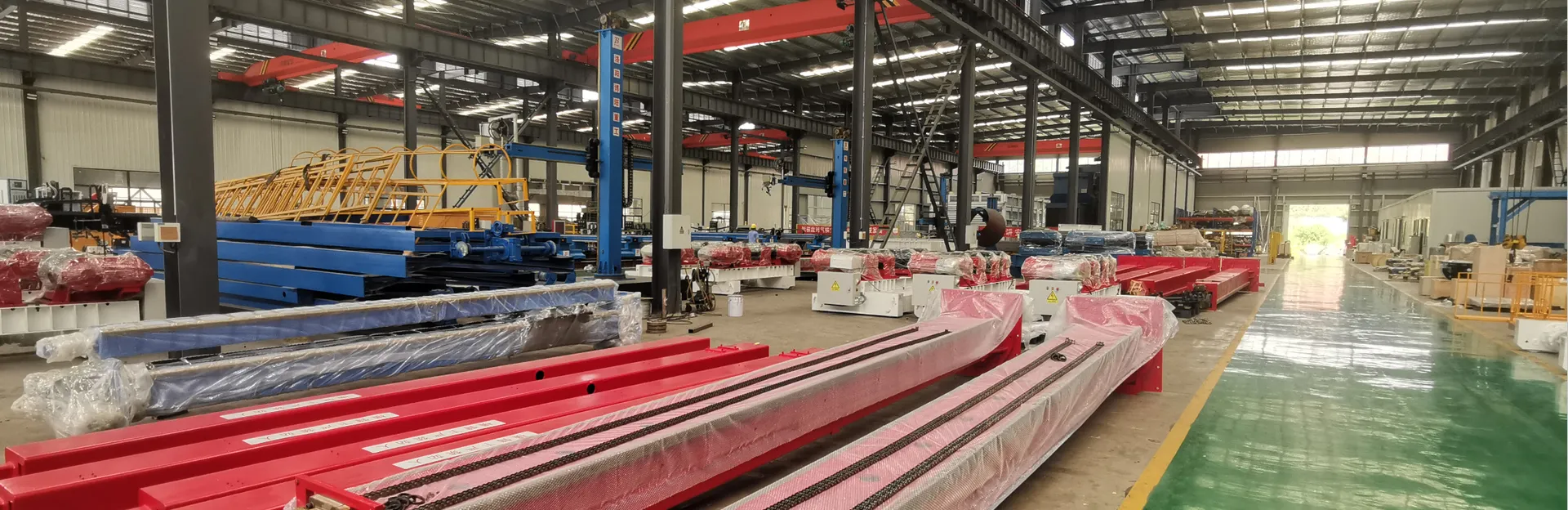
When precision welding demands consistent, repeatable positioning, even the smallest rotational play can introduce defects in tacking and final welds. Traditional rotators with inherent backlash cause misalignment, arc instability, and rework—costly issues in automated or high-tolerance fabrication. The zero-backlash rotator design directly addresses this challenge by eliminating mechanical clearance between driving components. This article examines how BOTA engineers have engineered a rotator that delivers truly seamless tacking and welding cycles, providing a technical foundation for production managers and welding engineers evaluating long-term quality assurance.
Backlash refers to the lost motion between meshing gears or worm drives when the direction of rotation reverses. In welding rotators, this clearance manifests as a momentary lag between controller command and actual workpiece movement—devastating for tacking sequences where every point must align with the previous pass. Zero-backlash design eliminates this gap through preloaded gear meshing or split-worm technology, ensuring that the rotator responds instantaneously to positional commands. The result is a continuous, uninterrupted arc without skips or wander, critical for both manual tacking operations and robotic welding cells.
BOTA employs a dual-worm configuration with spring-loaded preload that maintains constant tooth contact under all load conditions. Unlike conventional single-worm reducers that rely on gravity or minimal clearance for rotation, this architecture forces the worm and wheel surfaces to remain in intimate contact, transmitting torque without any lost motion. Measured repeatability under dynamic loading shows angular deviation below 0.01 degrees, a figure unattainable by standard rotators. For tacking—which typically requires multiple start-stop cycles—this translates to perfect alignment of every tack weld, preventing stress concentrations in the final joint.
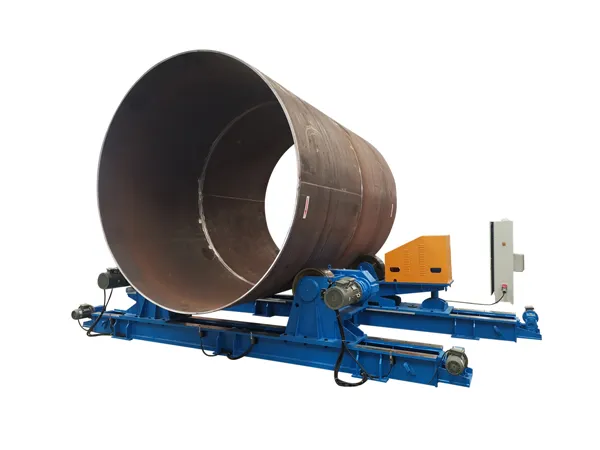
Achieving zero backlash in a rotator that must also handle heavy payloads and variable speeds is an engineering challenge. BOTA's solution combines three interdependent sub-systems: precision-ground worm gear sets, a patented preload adjustment mechanism, and a rigid housing designed to minimize thermal deformation during continuous welding. The preload mechanism allows field calibration without disassembly, maintaining zero-clearance even after thousands of operating hours.
Beyond mechanical design, the rotator's servo drive system compensates for any residual elastic deformation through real-time torque feedback. When welding current creates transient thermal expansion, the controller adjusts motor torque to maintain commanded position. This synergy between hardware and software ensures that the zero-backlash characteristic remains consistent throughout the weld cycle—from tacking to final seam. BOTA rotators have demonstrated positional stability within ±0.02 mm per revolution under full rated load in third-party lab tests.
The difference between zero-backlash and standard rotators becomes evident when comparing metrics that directly affect weld quality and production efficiency.
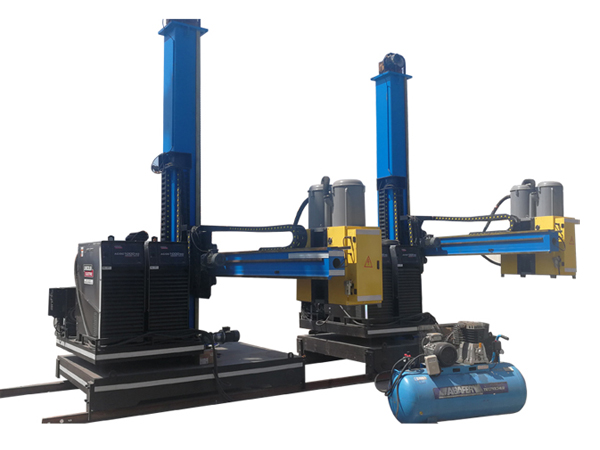
Zero-backlash rotators have proven particularly valuable in industries demanding high-integrity welds with minimal rework. In orbital pipe welding, where the root pass must be precisely aligned for subsequent fill passes, BOTA rotators enable single-sided tacking without internal backing rings. Large-diameter vessel fabricators report reducing tack removal time by 40% after switching from standard rotators. For robotic welding cells producing structural components, zero-backlash positioning allows programmers to use smaller positional tolerances, speeding up teach pendants and reducing cycle times.
One wind tower manufacturer integrated BOTA zero-backlash rotators into their longitudinal seam welding line. Prior to adoption, tacking required two weld operators to manually correct for rotation lag—adding 15 minutes per section. With zero-backlash rotators, a single operator can now oversee the automated tack cycle. Defect rates due to misaligned tack welds dropped from 12% to below 1%, directly reducing grinding and rework labor. The rotators have operated continuously for over 8,000 hours without requiring backlash adjustment, validating the long-term stability of the design.
Not all zero-backlash designs are equal. Key selection criteria include load capacity at maximum speed, thermal compensation range, and whether the preload mechanism is field-adjustable or factory-set. BOTA offers multiple frame sizes with payloads from 100 kg to 50,000 kg, each engineered to maintain zero backlash across the full speed range. For applications requiring intermittent tacking followed by continuous welding, BOTA's integrated cooling system prevents thermal growth from affecting positional accuracy—an often-overlooked factor. We recommend requesting a positional repeatability chart under simulated welding heat loads to verify that the rotator meets your specific process requirements.
Even the best zero-backlash rotator can suffer degraded performance if mounted on a flexible foundation or coupled with an imbalanced workpiece. BOTA provides detailed mounting specifications including minimum fastener torque and foundation stiffness requirements. Additionally, the drive system's encoder resolution should match the required tacking precision—a minimum of 10,000 pulses per revolution is recommended for most automated applications.
In summary, the move to zero-backlash rotator design is not merely a specification upgrade; it is a fundamental shift toward process reliability. For tacking operations that demand seamless transitions between weld points, and for continuous welding that cannot tolerate arc irregularities, BOTA's engineering provides the mechanical and control rigor needed to achieve first-pass quality consistently. By eliminating backlash, fabricators eliminate the root cause of many positional weld defects, ultimately reducing costs and increasing throughput. Evaluating your current rotator's performance against the metrics discussed here will reveal whether zero-backlash technology belongs in your next production investment.
No. 1 Intersection of Chuangye Avenue and Weilai Avenue,
Yiyang County,Luoyang City, Henan Province, China
+86 400-0379-069
Copyright © 2023 An Automated Welding and Cutting Equipment Manufacturer Focusing on Welding Column Boom and Welding Rotator | All Rights Reserved Technical support: ShangXian