
Self-Aligning vs Conventional Welding Rotators Explained
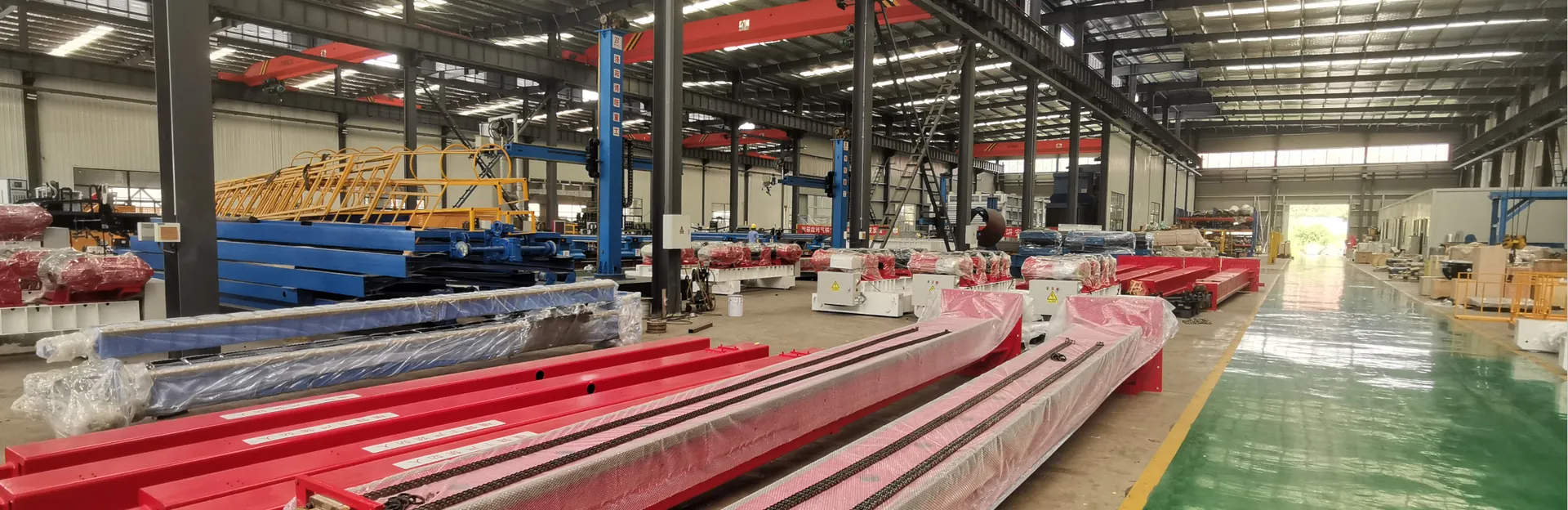
Choosing a welding rotator is rarely about the rollers themselves. It is about how much time your operators spend adjusting them. A conventional rotator holds a fixed roller spacing, so every change in workpiece diameter requires a manual setup before the first arc is struck. A self-aligning rotator uses pivoting roller arms that let the workpiece find its own center under its own weight. That single mechanical difference ripples through scheduling, labor cost, floor space, and safety. This article explains how both designs work, compares them against the criteria that matter to fabricators, and shows which applications justify which machine.
Both machines do the same fundamental job: rotate a cylindrical workpiece at a controlled speed while welding proceeds along a seam. The distinction lies in how the rollers are mounted and how the machine reacts when the workpiece diameter changes.
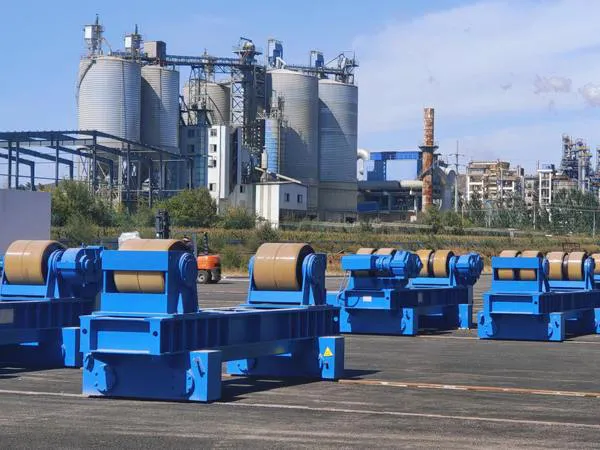
On a conventional unit, the drive roller and the idler roller sit in fixed housings on a common bed. Their center distance is set for a defined diameter band and changed only by mechanical means: slotted bolt holes, lead screws, or hydraulic cylinders that travel one housing along the base. Adjustment is incremental, and returning to a previous setting depends on the operator's ability to reproduce it accurately. The design is simple, rigid, and predictable, which is why it still dominates high-volume work where one diameter runs for hours or days at a time.
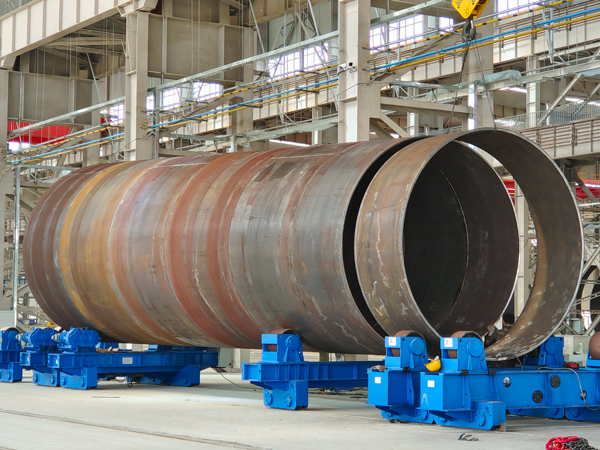
A self-aligning rotator mounts each roller on a pivoting arm. When a workpiece is lowered onto the machine, its own weight forces the arms apart or draws them together until the rollers contact the surface tangentially. The load settles into a stable, centered position without operator input, and the same machine covers a wide diameter range. On many designs both rollers are driven, so torque is distributed across two contact points instead of one, which improves traction on heavy shells, painted surfaces, and clad material.
The practical consequence is that diameter changeover becomes a lifting operation rather than an adjustment operation.
| Criterion | Conventional Rotator | Self-Aligning Rotator |
|---|---|---|
| Diameter range per setup | Narrow band; repositioning required between sizes | Wide range; the arms follow the workpiece |
| Changeover effort | Manual adjustment of roller spacing, then verification | Load and rotate; centering is automatic |
| Center height consistency | Varies with spacing setting | Relatively constant across the working range |
| Mixed-diameter throughput | Lower, because setup time is repeated | Higher, because setup time nearly disappears |
| Single-diameter throughput | Excellent once set | Comparable, with slightly more compliance in the arms |
| Mechanical complexity | Low | Moderate; pivot bearings and linkage need attention |
| Initial cost | Generally lower for a given capacity | Generally higher, offset by labor savings |
| Operator skill required | Higher; setup judgment affects weld position | Lower; centering is a property of the design |
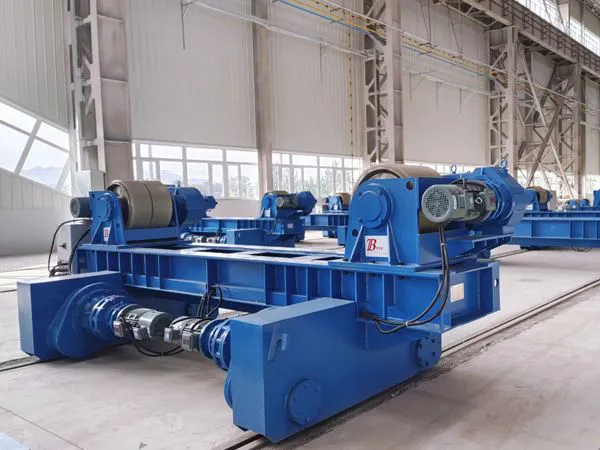
If a typical week includes several pipe sizes, a pressure vessel, and a repair job, setup time is the dominant cost. Self-aligning rotators remove most of that cost, and the operator spends the day welding instead of adjusting housings and checking center height.
Where the same pipe diameter runs for weeks, the self-aligning advantage is rarely exercised. A conventional rotator set once and left alone delivers the same output for less capital, and its rigidity is an asset under continuous duty.
Heavy shells demand load capacity and reliable traction. Self-aligning machines with dual drives distribute torque across two rollers and tolerate the slight dimensional variations found in rolled and welded shells, which reduces slipping and surface marking.
Thin-wall pipe and tube deform easily under concentrated roller pressure. Self-aligning geometry spreads contact more evenly across the diameter range, and the automatic centering keeps the seam at a consistent height for orbital or automated welding heads.
The purchase price is the visible number, but the operating cost is where the two designs diverge. Every changeover consumes production time, and in a shop that switches diameters several times per shift, that time compounds quickly across a year. Labor is not the only factor: a rotator that requires an operator to reach into the machine to reposition housings introduces a pinch and crush exposure that a load-and-go design largely avoids.
Safety also extends to load stability. A workpiece that is not properly centered can creep, drift axially, or load one roller unevenly. Self-aligning arms correct this passively, while conventional machines rely on the operator getting the spacing right. Where the workpiece is heavy and the seam is critical, that passive correction is worth more than the price difference.
Ask two questions. How many different diameters will pass through this station in a month, and how much does an hour of that station's downtime cost? If the answer to the first is more than a handful and the second is significant, the self-aligning premium is recovered through setup time alone. If the answer to the first is one, the conventional machine is the efficient choice.
Suppliers who build both configurations, such as BOTA, can usually advise on which design suits a specific diameter mix rather than steering every buyer toward a single platform. Ask for the changeover procedure in writing and confirm how center height behaves across your full diameter range.
Often yes, within its rated diameter and load range. The trade-off is that a single self-aligning machine may have a lower maximum capacity than a dedicated conventional unit sized for one large diameter, so check the capacity curve rather than the headline number.
The centering geometry is self-correcting, so wear in the pivot bearings affects smoothness more than centering. Routine inspection of pivot pins, roller condition, and drive alignment keeps performance consistent.
Yes, when the diameter changes are few and predictable, or when the machine will be dedicated to a fixed welding cell with hard automation. In those cases rigidity and simplicity outweigh changeover speed.
Confirm rotation speed accuracy, axial drift under load, roller contact pattern on your actual workpieces, and that center height stays within the range your welding head requires across the full diameter span.
The choice between self-aligning and conventional welding rotators comes down to how your shop uses its floor time. Self-aligning machines trade a higher purchase price for faster changeover, wider diameter coverage, and less reliance on operator judgment. Conventional machines trade flexibility for lower cost and greater rigidity where production is stable. Match the design to your diameter mix and your downtime cost, and the rotator becomes a throughput asset rather than a setup burden.
Welding Rotator Load Capacity: How to Match Tonnage
No information
No. 1 Intersection of Chuangye Avenue and Weilai Avenue,
Yiyang County,Luoyang City, Henan Province, China
+86 400-0379-069
Copyright © 2023 An Automated Welding and Cutting Equipment Manufacturer Focusing on Welding Column Boom and Welding Rotator | All Rights Reserved Technical support: ShangXian