
How to Calculate Load Capacity and Center of Gravity for Welding Positioners: A Comprehensive Practical Guide
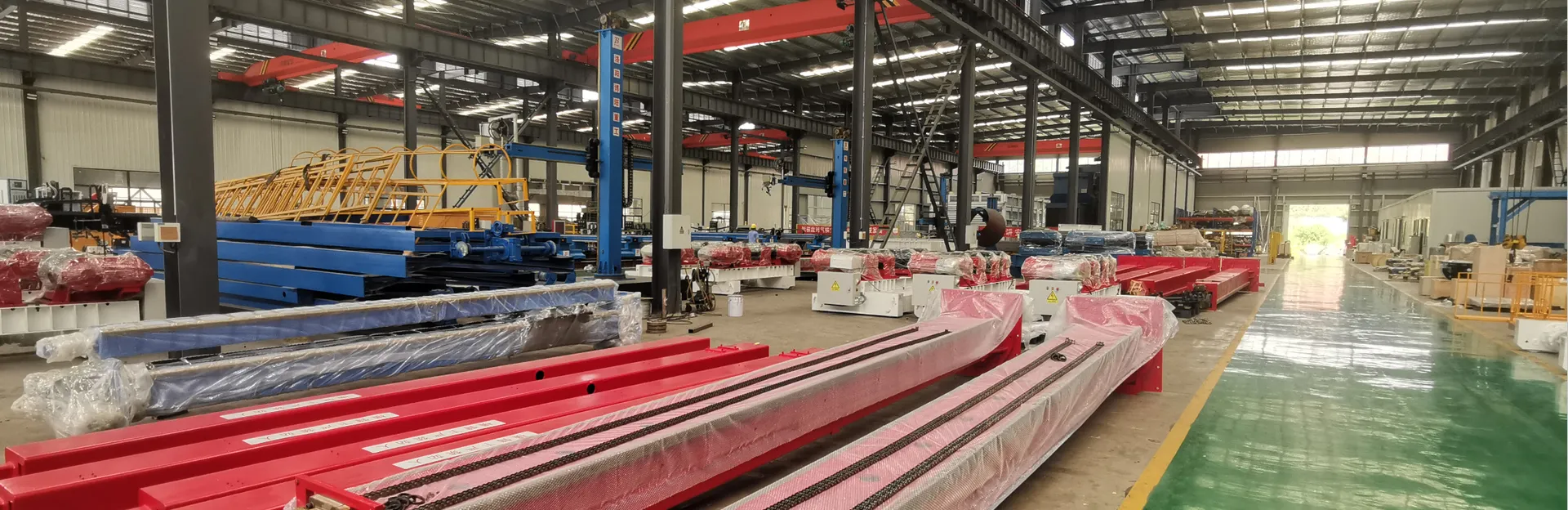
In today’s advanced manufacturing environment, welding positioners have evolved from simple support devices to indispensable tools that enhance both productivity and precision. These devices allow operators to rotate, tilt, or manipulate heavy workpieces safely, enabling access to complex angles without compromising welding quality or operator ergonomics. Despite their apparent simplicity, using welding positioners effectively requires a thorough understanding of load capacity and the center of gravity (CG) of the workpiece. Neglecting these critical calculations can result in equipment failure, misaligned welds, or even serious workplace accidents.
This guide is designed for engineers, welding professionals, and manufacturing managers to provide practical insights on determining load capacity and accurately locating the center of gravity for welding positioners, helping ensure safety, efficiency, and precision in all welding operations.
The load capacity of a welding positioner refers to the maximum weight it can safely support and manipulate. Unlike a static weight limit, this rating incorporates several engineering factors, including the device’s structural integrity, motor power, gear ratios, and integrated safety margins. Exceeding this capacity can place undue stress on the mechanical components, leading to accelerated wear, reduced lifespan, or sudden failure.
Workpiece Weight
The foremost factor is the total weight of the object being welded. This includes not only the raw material but also any fixtures, clamps, or temporary holding devices. Overlooking these can inadvertently exceed the rated capacity.
Rotational Moment (Torque)
Load capacity is not just about weight; it also considers the torque generated when a workpiece is rotated or tilted. A heavier workpiece positioned farther from the axis of rotation increases the torque exponentially, putting additional strain on the motors and bearings.
Positioner Geometry
The size and shape of the table or fixture significantly affect how the load is distributed. Larger radii or extended platforms increase bending forces, necessitating careful attention to weight placement.
Safety Factor
Manufacturers typically design positioners with a safety factor ranging from 1.5 to 2.0 times the expected working load. This margin accounts for dynamic forces, vibration, wear over time, and unexpected shifts in the workpiece.
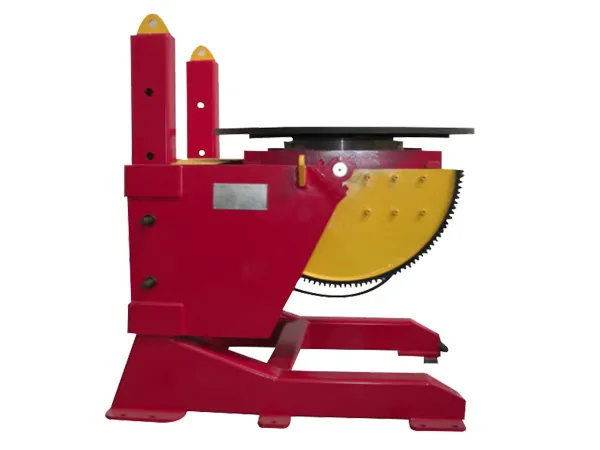
A simple yet effective method to understand load capacity involves considering both weight and distance from the rotational axis:
Effective Load=Maximum Rated Torque/Distance from Axis to Workpiece CG
This equation demonstrates that even if a workpiece’s weight is within the rated limits, extending it farther from the rotation axis dramatically increases mechanical stress. Proper load distribution and careful positioning are therefore critical to prevent undue wear and ensure safe operation.
Determining the Center of Gravity (CG)
The center of gravity is the point where the mass of a workpiece is evenly distributed in all directions. Accurate CG determination is crucial because misalignment can cause tipping, uneven stress on the positioner, and overloading of motors and gears.
Geometric Approach
For simple, uniform shapes, the CG often coincides with the geometric center. For example, the midpoint of a rectangular steel plate typically serves as its CG.
Composite Object Calculation
For irregular assemblies or welded structures, break the object into simpler components. Determine the CG of each component and then compute the overall CG using weighted averages:
XCG=∑wi∑(xi⋅wi),YCG=∑wi∑(yi⋅wi),ZCG=∑wi∑(zi⋅wi)
Here, xi,yi,zi represent the coordinates of each component’s CG, and wi is the weight of that component.
Experimental Method
For irregular or unknown-density workpieces, suspend the object using two or more points and trace the lines of equilibrium. The intersection of these lines provides a practical approximation of the CG.
Aligning the workpiece’s CG with the positioner’s rotational axis ensures:
Even distribution of forces, reducing vibration and wear.
Minimized stress on motors, bearings, and gear assemblies.
Stable rotation, particularly for large or asymmetrical assemblies.
Enhanced weld quality and precision, especially for high-tolerance components.
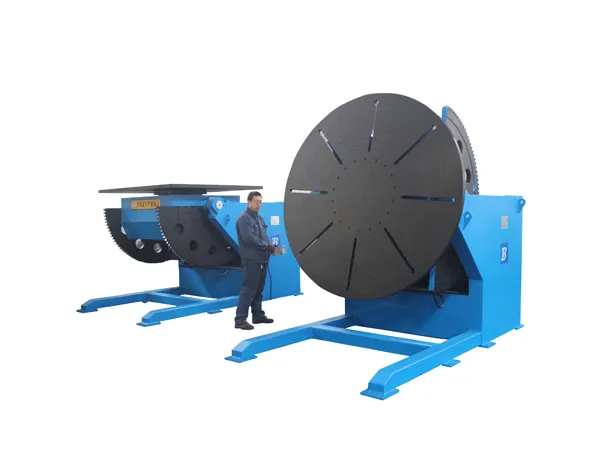
Always Verify Weight
Double-check the total weight of the workpiece, including fixtures or clamps, before mounting.
Consult Manufacturer Guidelines
Each positioner model has unique load ratings and permissible CG offsets. Following the manual prevents unsafe operation.
Use Balancing Aids
Counterweights, adjustable clamps, or supports can help align the CG with the rotation axis.
Avoid Overreaching
Extending a heavy workpiece far from the center increases torque beyond rated limits, even if the weight itself is permissible.
Routine Maintenance
Regular inspection of bearings, gears, and fasteners maintains load capacity and prevents unexpected failures.
Document Setup for Repeatability
Recording workpiece positioning, CG, and load distribution helps replicate safe and efficient setups in recurring welding tasks.
Calculating load capacity and determining the center of gravity are essential steps for using welding positioners safely and effectively. By understanding these principles, manufacturers and welding professionals can:
Extend the lifespan of welding equipment
Improve weld quality and precision
Maintain a safe working environment
Optimize workflow efficiency
Whether handling small components or large industrial assemblies, a thorough load analysis and careful CG alignment transform a welding positioner from a simple mechanical aid into a highly efficient productivity tool. Investing time in proper calculations and setup ensures every welding project is executed with maximum safety, precision, and operational efficiency.
No. 1 Intersection of Chuangye Avenue and Weilai Avenue,
Yiyang County,Luoyang City, Henan Province, China
+86 400-0379-069
Copyright © 2023 An Automated Welding and Cutting Equipment Manufacturer Focusing on Welding Column Boom and Welding Rotator | All Rights Reserved Technical support: ShangXian